
Door Closer Nomenclature
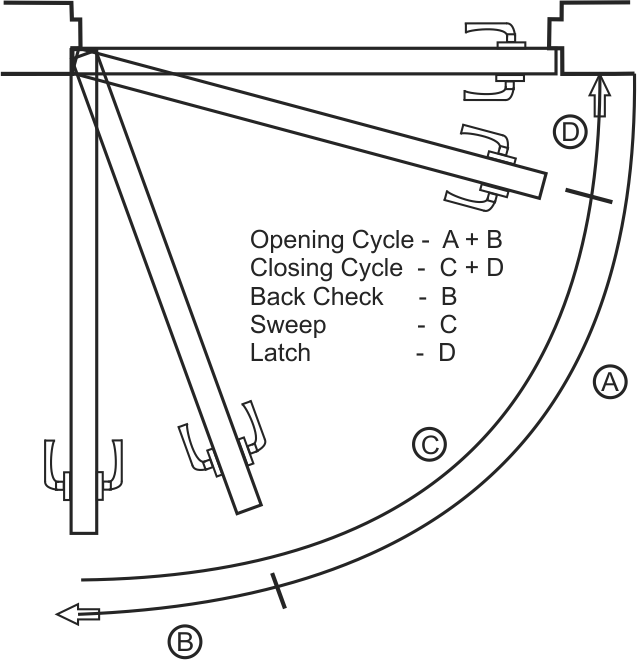
Closer Cycles
| Closing Cycle: | The entire length of travel from where the door is in the fully open position until the door is completely closed and latched |
| Opening Cycle: | The entire length of travel from where the door in the closed position until it reaches the fully open position including the back check cycle |
| Latch: | The last 15 degrees of the closing cycle before the lock engages the strike. This cycle allows the door speed to be decreased before it latches reducing the stress on the frame |
| Back Check: | The last 15 Degrees of the opening cycle before the closer reaches its maximum opening limit.This cycle slows the door down before it reaches the mechanical end of the opening cycle. |
| Sweep: | The distance between the end of the opening cycle until the beginning of the latch cycle |
Technical Note: Back check should never be used to replace an overhead stop or a physical door stop
Adjustments and Options
| Delay: | An pause at the end of the opening cycle before the closing cycle begins |
| Power Adjustable: | A mechanical function of a door closer that allows a person to increase or decrease the opening and closing strength of the closer |
| Drop Plate: | A metal plate used when a ceiling, frame or door condition does not permit any of the standard surface closer mounting styles |
Surface Closer Mountings
| Regular Arm: | Pull side mounting where the standard closer arm is used. This mounting is the most geometrically efficient for the closer |
| Top Jamb: | Push side mounting where the closer is mounted on the frame and the arm on the door. This mounting is the next best alternative to the Regular arm mounting. Suggested for exterior doors |
| Parallel Arm: | This push side application provides the most appealing appearance for a surface mounted door closer having a standard arm. With the arm running parallel to the door, this application is less prone to vandalism. A Parallel Arm Application will all the door to swing up to 180 degrees in one direction, but due to the arm configuration there is a 25 percent loss of power compared to regular and top jamb applications |